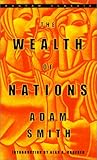
Product Description
The Wealth of Nations
by Adam Smith
It is symbolic that Adam Smiths masterpiece of economic analysis, The Wealth of Nations, was first published in 1776, the same year as the Declaration of Independence.
In his book, Smith fervently extolled the simple yet enlightened notion that individuals are fully capable of setting and regulating prices for their own goods and services. He argued passionately in favor of free trade, yet stood up for the little guy. The Wealth of Nations provided the first--and still the most eloquent--integrated description of the workings of a market economy.
The result of Smiths efforts is a witty, highly readable work of genius filled with prescient theories that form the basis of a thriving capitalist system. This unabridged edition offers the modern reader a fresh look at a timeless and seminal work that revolutionized the way governments and individuals view the creation and dispersion of wealth--and that continues to influence our economy right up to the present day.
Rate Points :4.5
Binding :Mass Market Paperback
Label :Bantam Classics
Manufacturer :Bantam Classics
ProductGroup :Book
Studio :Bantam Classics
Publisher :Bantam Classics
EAN :9780553585971
Price :$7.95USD
Lowest Price :$4.42USD
Customer ReviewsA Must Read For Every Economist
Rating Point :4 Helpful Point :2
This book is so widely cited and interpreted contrary to the authors original thought, that every economist should read it completely to avoid being misled by such incorrect interpretations.
First, let us take the "invisible hand" metaphor. When I have studied economy in the University, I was taught that almost the entire book is devoted to the "invisible hand" which means "self-corrective markets", "liberalism", "Laissez-faire" and "state non-intervention". After reading this book, I have found out that Adam Smith did use the term "invisible hand" only once in the entire book, in the discussion of domestic versus foreign trade.
To illustrate the point, let me quote the text where term "invisible hand" is used: "First, every individual endeavours to employ his capital as near home as he can, and consequently as much as he can in the support of domestic industry, provided always that he can thereby obtain the ordinary, or not a great deal less than the ordinary profits of stock. Thus, upon equal, or nearly equal profits, every wholesale merchant naturally prefers the home trade to the foreign trade of consumption, and the foreign trade of consumption to the carrying trade. In the home trade, his capital is never so long out of his sight as it frequently is in the foreign trade of consumption. ...Secondly, every individual who employs his capital in the support of domestic industry, necessarily endeavours so to direct that industry, that its produce may be of the greatest possible value. ...As every individual, therefore, endeavours as much as he can, both to employ his capital in the support of domestic industry, and so to direct that industry that its produce maybe of the greatest value every individual necessarily labours to render the annual revenue of the society as great as he can. He generally, indeed, neither intends to promote the public interest, nor knows how much he is promoting it. By preferring the support of domestic to that of foreign industry, he intends only his own security and by directing that industry in such a manner as its produce may be of the greatest value, he intends only his own gain and he is in this, as in many other cases, led by an invisible hand to promote an end which was no part of his intention. Nor is it always the worse for the society that it was no part of it."
After reading this book, I have found out that Adam Smith was influenced by French Physiocrats. The Physiocrats saw the true wealth of a nation as determined by the surplus of agricultural production over and above that needed to support agriculture (by feeding farm labourers and so forth). Other forms of economic activity, such as manufacturing, were viewed as taking this surplus agricultural production and transforming it into new products, by using the surplus agricultural production to feed the workers who produced the extra goods. While these manufacturers and other non agricultural workers may be useful, they were seen as sterile in that their income derives ultimately not from their own work, but from the surplus production of the agricultural sector.
I have found out that this book is not about "invisible hand" or "Laissez-faire". It is quite a complete study that covers almost every basic aspect of the economy, and remains an effective introduction to economics to this day.
This book is so often mischaracterized and politicized that I suggest you to read it completely by yourself. This is a must read for every economist. You can get an audio version of this book to avoid lengthy read.
Excellent
Rating Point :5 Helpful Point :1
This book is filled with great information you will find useful as well as having to find new things you never knew about. I will recommend this book to anyone and everyone.
Good Job Bantam. A Wealth of Knowledge. Smart Size and Price
Rating Point :4 Helpful Point :1
For those who dont have time to sit through over 1200 pages, this book has an index. Theres more than just economy, banks, money, tax, and trade matters in here.
This is packed with quotations about ancient Egypt, Greece, and Rome. He commented on religion, religious sects, and how smaller ones tended to be overly rigorous and unsocial.He wrote a couple of lines on Bible translation too.
He mentioned India, China, as well as Montesque, Locke, and David Hume.
He wrote about schools, universities, and philosophy.
Cant beat the size, or the price as I tend to be partial to compact paperbacks.
Libertarians and conservatives tend to cherry pick this volume.
The reason why is because its a fruitful read.
Libertarian think tanks who charge an arm and a leg for their books should take notice. Bantam got the price and the size just right.
I would recommend along with this title the Bantam edition of Democracy in America by de Toqueville, which also has an index.
Some of us are busy, and strapped for cash.
Ignore at your own risk
Rating Point :5 Helpful Point :0
This work is, or should be, required reading for all Americans in High School, College or anytime.
A Must Read For Every Economist
Rating Point :5 Helpful Point :1
The Wealth of Nations (An Inquiry into the Nature and Causes of The Wealth of Nations) by Adam Smith. Published by MobileReference (mobi).
A great introduction to modern economics. This book gives the motivation for many modern economic concepts that is often lost in mathematical formalism.
Similar ItemCapitalism and Freedom: Fortieth Anniversary Edition  Selected by the Times Literary Supplement as one of the "hundred most influential books since the war"How can we benefit from the promise of government while avoiding the threat it poses to individual freedom? In this classic book, Milton Friedman pr
Free to Choose: A Personal Statement  The international bestseller on the extent to which personal freedom has been eroded by government regulations and agencies while personal prosperity has been undermined by government spending and economic controls. New Foreword by the Authors Index.
The Prince  This is a beautifully designed, large format edition (6"x9") of Niccolo Machiavellis classic, THE PRINCE. Translated, with an astute introduction, by the leading Machiavelli scholar W. K. Marriott. Hugely influential, THE PRINCE is must-reading for a
The General Theory of Employment, Interest and Money  The General Theory is nothing less than an epic journey out of intellectual darkness. That, as much as its continuing relevance to economic policy, is what makes it a book for the ages. Read it, and marvel.
The Communist Manifesto (Penguin Classics)  Originally published on the eve of the 1848 European revolutions, The Communist Manifesto is a condensed and incisive account of the worldview Marx and Engels developed during their hectic intellectual and political collaboration. Formulating the pri
Selected by the Times Literary Supplement as one of the "hundred most influential books since the war"How can we benefit from the promise of government while avoiding the threat it poses to individual freedom? In this classic book, Milton Friedman prThe international bestseller on the extent to which personal freedom has been eroded by government regulations and agencies while personal prosperity has been undermined by government spending and economic controls. New Foreword by the Authors Index.This is a beautifully designed, large format edition (6"x9") of Niccolo Machiavellis classic, THE PRINCE. Translated, with an astute introduction, by the leading Machiavelli scholar W. K. Marriott. Hugely influential, THE PRINCE is must-reading for aThe General Theory is nothing less than an epic journey out of intellectual darkness. That, as much as its continuing relevance to economic policy, is what makes it a book for the ages. Read it, and marvel.Originally published on the eve of the 1848 European revolutions, The Communist Manifesto is a condensed and incisive account of the worldview Marx and Engels developed during their hectic intellectual and political collaboration. Formulating the pri
0 ความคิดเห็น:
แสดงความคิดเห็น